What Sets a High-Quality Solar Panel Apart?
With the world continuing to transition rapidly toward renewable energy, solar power continues to dominate the energy landscape. In 2024, the International Energy Agency (IEA) reported solar PV represented over 60% of all new renewable energy globally – a clear sign people and industry are investing in a cleaner and sustainable future.
As demand grows, one question stands out above the others: what is truly considered a high-quality solar panel?
While most solar panels all may appear to look the same at first glance, they will provide varying system performance, durability, and efficiency based on their design, structure, and testing procedures.
Understanding the Anatomy of a Solar Panel
Prior to examining the characteristics of a panel that would otherwise be considered “high quality”, we need to first review the base components that make up every solar module.
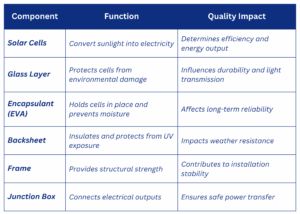
Since every element in the panel is related to the performance of a panel as a whole, if any one component is inferior-for example, a low-end encapsulant or frame-then its life is shortened.
Key Factors That Define High-Quality Solar Panels
It’s not enough to just say that a high-quality solar panels simply perform well — they are engineered to withstand harsh weather, deliver consistent reliability, and maintain their efficiency for decades.
Efficiency: The Fundamental Concept of Performance
Efficiency describes how effectively a photovoltaic panel is able to convert sunlight into useful electric power. The best panels have efficiencies of 20-23%, depending on technology.
Different Type of Cell Technologies
- Monocrystalline Solar panels: These are of a single crystal structure, have more efficiency, and look modern.
- Polycrystalline Solar panels: less expensive than monocrystalline, but less efficient since they have multiple crystal boundaries.
- PERC (Passivated Emitter Rear Contact) – This technology is responsible for improving light absorption and performance in low-light conditions.
- HJT (Heterojunction Panel) panel: This includes a combination of thin film technologies and crystalline technologies. HJT panels reliably maintain higher levels of efficiency and generate less temperature loss.
- Tunnel Oxide Passivated Contact (TOPCon): It is like an ultra-modern evolution of PERC technology in solar that provides higher conversion efficiency, better temperature tolerance and improved long-term reliability.
Durability and Construction Quality
A solar panel must endure decades of outdoor exposure to the sun- hot and dry, wet, dirty, snowy, and available in any other climate condition.
Quality of Solar Materials
- The solar glass used in panels must be at least 3.2 mm thick, anti-reflective.
- The Solar Panel Frame must be light weight. Also, as they are put outside hence, it must prevent any corrosion and remain rigid. Hence, integration aluminum for solar frame is recommended.
- High-quality Solar Backsheet: Should absorb UV radiation and provide insulation from electrical insulation.
Climate Resilience
The panels should be tested for the following:
- Thermal cycling to beat in extreme heat and cold weather
- Humidity freeze in case of condensation and freeze
- Mechanical load to bear snow and wind pressure
- Salt mist and ammonia resistance especially in coastal and agricultural regions
Panels that meet the international standard (IEC 61215 and IEC 61730) can easily last 25-30 years with little degradation. Hence, while investing in panels, one must check all the solar panel certifications.
Power Output and Degradation Rate: Standard vs. High-Quality Panels
A high-quality panel maintains its performance over time.
|
Panel Type |
Average Annual Degradation |
Power Output After 25 Years |
|
Standard Panels |
0.7% per year |
~82% |
| High-Quality Panels | 0.25–0.35% per year |
90–93% |
This difference might seem small but can lead to thousands of kilowatt-hours more power over the system’s lifetime.
Temperature Coefficient
Solar panels are not most efficient when hot, a lower temperature coefficient means the panels perform better at hot temperature.
- Better quality panels: -0.26% to -0.35%/°C
- Average panels: -0.40% to -0.50%/°C This means that these better panels lose less power when the temperature rises, and are, therefore, better suited for tropical and semi-arid environments.
Multi-Stage Testing
Panels of high quality are subjected to Electroluminescence, Flash and outdoor performance testing to identify micro-cracks that are not identified by naked eye, to check real-time efficiency and lastly, power output.
While arduous, all steps ensure only panels without defects are shipped to market.
Solar Certifications: A Hallmark of Trustworthiness
Certifications are assurances of a panel’s reliability, safety, and performance consistency.
International Certifications
|
Certification |
Purpose |
|
IEC 61215 |
Verifies mechanical and electrical durability |
|
IEC 61730 |
Ensures electrical safety and fire resistance |
|
ISO 9001 |
Guarantees quality management systems |
|
ISO 14001 |
Ensures environmental responsibility in production |
|
UL 1703 / UL 61730 |
Confirms product safety for North America |
Classification Based on Tier
Financial analysts frequently utilize the Bloomberg Tier 1 list to identify panel manufacturers with solid bankability and proven performance.
Tier 1 panels are seen as safer investments given their proven track records of quality and financial stability over the long term.
Warranty and After-Sales Support
A dependable warranty shows the manufacturer’s trust in their product.
Standard Warranty for Solar Panels
- For product warranty it’s around 10 to 15 years but it only covers manufacturing defects.
- And for the performance warranty it for around 25 to 30 years where they guarantees minimum power output
High-end panels typically extend both warranties, even offering 25 years for both product and performance.
After-Sales Support
Choose a manufacturers or distributors which have local service networks, offers fast replacement or repairing policy and are transparent in their customer support service. You might have a great product, it is ultimately only as good, as the after-sales support that you get with it.
The Difference Between Cost and Value: It’s More Than Just Money
While premium panels may cost 10-20% more up front, they produce a markedly higher return in the following ways:
- Higher efficiency and energy yield
- Lower maintenance costs
- Longer warranties and lifespan
- Improved performance in challenging weather situations
- In the long-term, energy savings with higher quality panels almost always turn out to be the cheaper investment.
The Future of Solar
The solar industry is gaining the ground rapidly, with up-to-date technologies daily which helps in improving efficiency, sustainability and cost.
Here are some latest trends in solar cell materials that you must know
- Bifacial Panels: Its a panel that collect sunglight from both sides unlike the standard panels which collect from one side only. THis allows the panels collecting 15% more energy.
- N-Type Cells: It’s a new generation cells that provide lower degradation and more light absorption.
- Perovskite Solar Cells: Low-weight technology that has demonstrated record efficiency.
- Recyclable Modules: The panels that are made with recyclable materials, can be easily then help to recycle solar panel. Which means more focus on sustainability and creating a circular manufacturing process.
At botton, these parameters will yield not just greater power generation, but also a better, greener, more sustainable future for tomorrow.
Quality is the True Hero
Selecting quality solar equipment is more than just selection based on wattage, and aesthetics. It’s a decision rooted in trust, manufacturing durability, and delivering performance consistently.
Quality solar module is an investment that allows the sun and the homeowner to capture more energy from every ray of sunlight, providing cleaner energy, a higher return on investment, and peace of mind for decades.
As the market continues to be flooded with materials and equipment, understanding the indicators of quality will help people make better energy decisions for the long term. After all, solar energy is not just a purchase, it is a 25-year relationship with the sun.
Explore More on Solar Blogs
Other Articles