How Solar Energy Is Revolutionizing the Power Sector?

The manner in which the world generates and consumes energy is undergoing faster change than ever before. From rooftops around the globe to rural fields in India, constant revolution in solar energy is also changing the power industry—no longer in the “experiment” phase, but as an unstoppable groundswell.
It’s about reframing the way we think about power itself, who makes it, who uses it, and how we all can be sustained.
The New Era of Energy
The Transition from Traditional Energy to Conscious Energy
For decades, the burden of energy production relied on oil and gas. Power plants pumped out energy but were a source of pollution and carbon emissions and climate issues. The model worked until it didn’t.
As energy production ramped up around the globe, so did awareness of the planet’s finite resources. The world needed a cleaner, smarter, and unlimited supplier of energy. That supplier was right above us—the sun.
The Solar Spark
The stock of solar energy initially gained traction slowly, then accelerated as technology improved and governments stimulated green initiatives. For Indian people, solar energy was not only an environmental option – it was a national aspiration. A strategy for energy independence and economic development.
India’s Solar Transformation: From Policy to Implementation
Government programs, like the Surya Ghar Muft Bijli Yojan and PM-KUSUM, have transformed the way India approaches energy. The systems of subsidies, tax incentives, and net metering have made solar energy not just affordable, but attainable.
India’s emphasis on building up renewable energy capacity has made solar energy one of the fastest-growing industries in the country. India’s target to achieve 300+ GW of solar energy by 2030 is more than just a number; it is a commitment to cleaner lives, sustainable growth, and economic development.
Local Change, Global Recognition
What makes India’s solar story even more compelling is the local empowerment with global leadership.
Rural communities are being electrically empowered with small-scale solar microgrids, while solar power plants, such as Bhadla Solar Park in Rajasthan, have become global benchmarks for capacity and efficiency.
More Advanced Panels, More Efficiency
In recent years, solar technology has come a long way. Bifacial and TOPCon panels have entered the market, enabling photovoltaic cells to harness sunlight from both sides of the panel thus allowing more generation without needing more space. Perovskite cells and thin-film modules are on the market now as well, allowing solar technology to deliver power in a lighter, more efficient manner, and at a reduced cost to install systems.
These advancements are not just technological advances, they are now enabling solar to be a viable option for many homes, schools, hospitals, and businesses in the United States.
The Impact of Smart Grids
The application of AI enabled smart grids has changed how we store energy and as importantly, how we distribute that energy. Smart grids balance supply and demand, can predict usage, and give us certainty in terms of reliability and trust.
The advancements in battery systems allow us to store solar, and improved battery systems provide access to that stored solar energy even when the sun is no longer shining. Thus, we are with continuous electricity powering millions of homes and businesses.
From Generating Power to Job Creation
Every installed solar panel is not only a source of energy, it is an opportunity.
The solar sector in India is creating thousands of jobs in manufacturing, installation, and service. At the community level, a surge in entrepreneurship has occurred as communities implement both rooftop and mini-grid systems.
Industrial and Commercial Adoption
Businesses are increasingly seeing both cost savings and sustainability through solar energy.
Factories, malls, and technology parks are switching to solar rooftops to reduce long-term energy costs. Ground-mounted solar systems in industrial parks are now providing consistent energy to large facilities, reducing reliance on traditional grids.
Power Where It Was Needed Most
Solar power has transformed darkness into opportunity in isolated villages where electricity was once a dream.
Off-grid solar systems are now providing electricity to schools, clinics, and homes. Farmers are using solar-powered water pumps to irrigate their fields, saving both money and diesel. This means more than improved infrastructure; it is enhancing education, healthcare, and livelihoods.
Community Solar Projects
Community-based solar projects are another quiet revolution happening in rural places. Villages that once relied on kerosene lamps now access power collectively through solar grids. The community-owned model builds economic and social capabilities.
Solar vs Traditional Power: A Fair Comparison
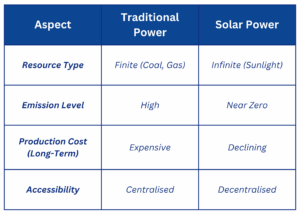
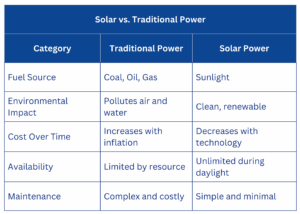
Solar energy has proven itself not just as an alternative but as a superior choice. Hence, if its solar vs traditional power, solar wins.
Impact on the environment: A healthier future
Reduction of Carbon Footprint
Unlike coal or gas plants, solar energy is emission-free; you’re still falling tons of CO₂ that would otherwise be injected into the atmosphere for each kilowatt of solar power generated.
Water Land Resource Efficiency
Solar panels use a much smaller volume of water than thermal power plants. Floating solar farms on reservoirs and lakes are also being developed to conserve land resources while producing power for both environmental and efficient purposes.
Recycling Use
In addition, recent advancements in recycling technology in solar have ensured that solar modules can also be recycled in the future after their 25-year use experiences. Hence, solar energy will remain a sustainable resource for future generations.
The Sun-Powered Future
The solar revolution is already here.
It’s powering homes, factories, and hearts. It’s proving that clean energy isn’t just about reducing emissions; it’s about building hope and resilience for generations to come.
India’s leadership in solar energy is shaping a global example: one where sustainability and progress walk hand in hand. At the heart of this transformation, companies like Vishakha Renewables are playing a vital role by driving innovations in the solar sector, promoting responsible manufacturing, and ensuring that renewable energy becomes a reality for everyone, not just a vision.
Solar energy isn’t merely transforming the power sector; it’s transforming lives. And as technology grows and awareness spreads, the brightest days of our energy future will be powered not by fuel, but by the sun itself, and by the people and organisations committed to harnessing its potential responsibly.
Read More
Other Articles