Solar Panel Certifications: How They are Certified for Long-Term Reliability?
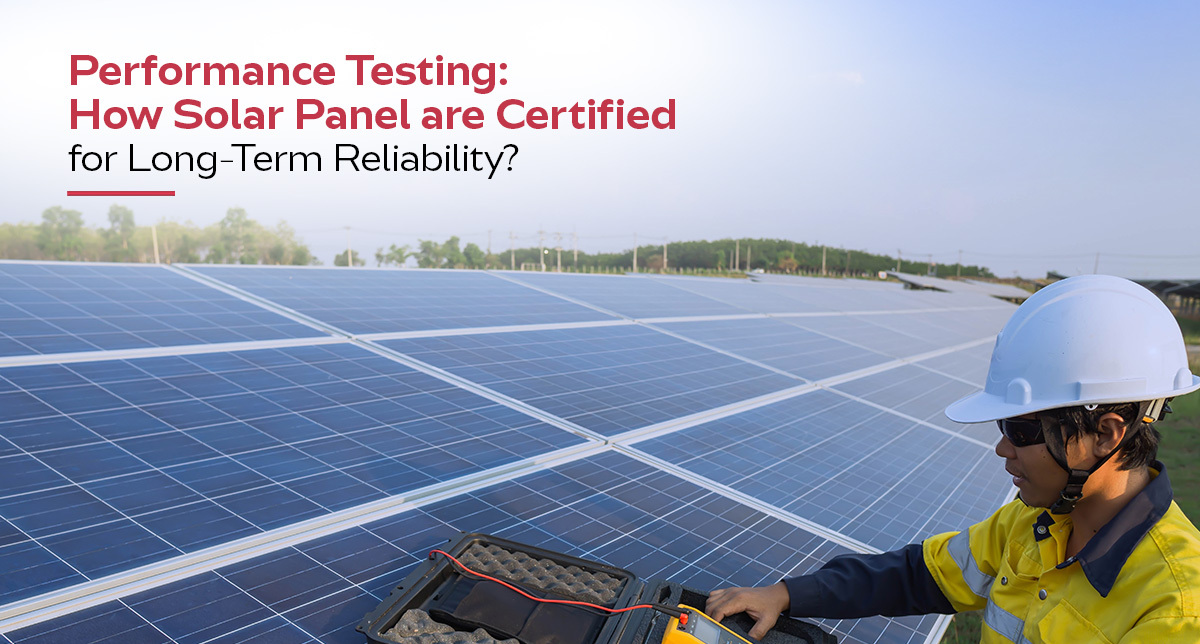
Choosing solar energy is a significant move, promising both a greener future and reduced energy costs. The true value of a solar panel extends far beyond its initial performance or cost; it’s all about how well it holds up over time. That’s why testing and certification are crucial.
Certified solar panels go through tough testing to prove they’re built to last, safe, and efficiently, even in conditions that mimic the real world. When you choose certified panels, you can be sure your solar panels will handle bad weather, keep working well, and protect your investment for a long time.
Why Is Solar Panel Testing and Certification so Important?
The importance of solar testing and certification for solar panels is hard to overstate.
Testing and certification of solar panels build trust among installers, homeowners, and businesses.
They serve as a benchmark, ensuring panels comply with global performance and safety regulations before they hit the market after production.
Reliable performance from the panels is guaranteed
Certification testing, performed in a controlled laboratory environment, evaluates how well a solar panel transforms sunlight into energy. This process allows for direct comparisons between panels from different manufacturers, and it also confirms that the reported energy output is both precise and trustworthy.
Proven durability in harsh conditions
Solar panel performance is influenced by a range of environmental conditions, encompassing high temperatures, heavy precipitation, strong winds, airborne contaminants, snow, and hail. Consequently, as demonstrated by external stress evaluations, certified panels are engineered to maintain operational integrity over extended periods, resisting corrosion, degradation, and diminished efficiency.
This strategy enables for the identification of potential improvements in the production process. Rigorous testing during the initial production phases allows for the detection of design flaws, material deficiencies, and manufacturing inconsistencies.
Therefore, this proactive strategy mitigates post-installation complications, thereby shielding consumers from the financial burdens associated with the repair or replacement of costly components.
This feature safeguards both individuals and the system itself. Safety is paramount in solar installations.To avoid potential dangers such as electrical shocks, fire risks, insulation breakdowns, or environmental damage, certified solar panels must meet stringent electrical and mechanical safety standards.
Key Certifications for Solar Panels: What to Check Before You Buy
Before buying a solar panel, confirm that the panels adhere to internationally accepted certification standards.
Performance and Longevity, as per IEC 61215
This certification assures that a solar panel will continue to perform effectively and maintain its structural soundness, even after extended exposure to various environmental factors like heat, cold, and UV radiation.
Safety Standards, known as IEC 61730, primarily focus on the safety of electrical systems, fire resistance, and mechanical integrity. This certification ensures the panel will function safely for as long as it’s in use.
UL 1703, the North American Safety Certification, is a recognized standard across North America. It guarantees the safety and performance of solar modules, having undergone rigorous testing.
Corrosion Resistance to Salt Mist, as stipulated by IEC 61701, is a certification that solar panels must possess to function effectively in coastal or high-humidity environments, where salt exposure can accelerate deterioration.
Resistance to Sand & Dust, according to IEC 60068-2-68, is a test designed to evaluate a panel’s ability to withstand sandstorms and dust accumulation without a reduction in performance, particularly in arid and desert regions.
Assessments of Solar Panel Reliability
Before mass production, solar panels must pass a series of rigorous tests to ensure their reliability. These assessments are aimed to evaluate the panels’ operational effectiveness, their estimated lifespan, and their safety during usage. The goal of this process is to ensure the panels are safe, efficient, and durable throughout their operational life.
In these investigations, the effects of prolonged natural stress are replicated within controlled laboratory environments to mimic the conditions encountered outdoors following extended exposure to environmental elements. The outcomes of these demanding tests have shown that solar panels can maintain their electricity generation capabilities, thereby protecting the structures upon which they are installed and preventing any electrical shocks or injuries during their operational lifespan.
Thermal cycling (TC)
The Thermal Cycling Test assesses a solar panel’s resilience to external temperature fluctuations, particularly those experienced throughout the day.
These panels undergo a sequence of repeated cycles, subjecting them to both elevated and reduced temperatures, alongside other severe thermal conditions. These temperatures can vary significantly, ranging from very cold to very hot. Consequently, the panel’s constituent materials—glass, silicon cells, solder joints, and frames—undergo continuous expansion and contraction due to these rapid temperature changes. The objective of this testing procedure is to determine whether these materials can withstand thermal stress without experiencing fracturing, delamination, or electrical failures. A successful Thermal Cycling Test suggests that the panels exhibit strong structural integrity and reliable electrical connections, thereby ensuring consistent performance even in environments characterized by substantial temperature fluctuations.
Assessment for Humidity Freezing (HF)
The Humidity Freeze Test is designed to evaluate the operational efficacy of solar panels when subjected to high humidity followed by freezing temperatures. The procedure involves subjecting the solar panels to elevated humidity, which is then succeeded by a rapid cooling phase, bringing the temperature just below freezing. This cycle is repeated several times to replicate the environmental challenges encountered in cold, mountainous areas, and also in locales prone to significant precipitation and frost.
A positive outcome from this test signifies that the panel’s sealing is intact, its moisture resistance is adequate, and its operational capacity is maintained under extreme conditions, encompassing both low temperatures and heavy rainfall.
Assessment for Damp Heat (DH)
The Damp Heat Test evaluates a solar panel’s ability to withstand prolonged exposure to high temperatures and high humidity.
These meteorological conditions are particularly prevalent in tropical and coastal areas. Panels are exposed to controlled environments, which are defined by high heat and humidity for extended periods, sometimes reaching thousands of hours. This assessment seeks to ascertain potential long-term degradation risks, encompassing corrosion, insulation failure, delamination, and power loss resulting from moisture penetration. Panels that perform well in the Damp Heat Test exhibit enhanced material quality and sealing, thereby ensuring consistent electrical insulation and energy output over extended durations, even in hot and humid conditions.
An Examination for Ultraviolet Exposure
The UV Exposure Test assesses a solar panel’s resilience to prolonged ultraviolet radiation originating from the sun. Ultraviolet (UV) radiation has the potential to degrade polymers, backsheet materials, encapsulants, and protective coatings, which can lead to discoloration, cracking, or diminished efficiency as the panel ages.
To simulate the effects of extended solar exposure within a condensed timeframe, the panels undergo a demanding test involving intense UV radiation. This process aims to determine the components’ resistance to premature degradation and to ensure the preservation of their structural integrity.
Consequently, solar panels that successfully complete the UV Exposure Test are more likely to maintain their efficiency, aesthetic qualities, and structural integrity over their lifespan.
Hail Impact Assessment
The Hail Impact Test assesses the resilience of solar panels against abrupt, high-velocity impacts, thereby simulating the conditions experienced during hailstorms. This evaluation is conducted by launching ice spheres, which are of a specific size and velocity, towards the panel’s surface to mimic the impact of hail. The primary objective is to confirm that both the tempered glass and the solar cells beneath it remain undamaged and continue to function normally following the impact. Consequently, a panel’s successful performance in this test indicates its capacity to endure extreme weather conditions without jeopardizing safety or electricity production.
Corrosion Assessment via Salt Mist Testing
The Salt Mist Corrosion Test is crucial for solar panels deployed in coastal or industrial regions, as the presence of salt accelerates the corrosion process. Metallic frames, joints, and coatings undergo corrosion resistance testing through exposure to a fine saltwater mist. This saline mist serves as the medium for assessing the corrosion resistance of metal frames, joints, and protective coatings. The central aims of this assessment are to ascertain the structural integrity and operational reliability of the structure and its associated electrical systems. The Salt Mist Corrosion Test requires aquatic displays. They can only get this title if they are able to maintain the strength, safety, and operating effectiveness of corrosive environments.
Potential Induced Degradation (PID)
If not addressed, PID can significantly reduce a panel’s efficiency over time. This evaluation simulates real-world conditions by subjecting panels to elevated system voltage while controlling temperature and humidity. Moreover, the panel’s construction, materials, and insulation are examined to gauge their capacity to minimize leakage currents and performance deterioration.
Panels that successfully complete the PID Test demonstrate reduced performance loss and enhanced long-term energy output in high-voltage solar installations.
Evaluating the System’s Voltage Bias
The System Voltage Bias Test serves to evaluate the performance of solar panels under prolonged exposure to continuous electrical voltage. This assessment is conducted on the panel’s insulation system, materials, and electrical components to ascertain their ability to withstand sustained voltage stress without experiencing breakdowns, leaks, or safety hazards. This assessment seeks to identify potential electrical issues that could lead to system failures or diminished performance. We do this by replicating real-world scenarios within systems connected to the electrical grid.
Certified solar panels undergo extensive testing to verify their effectiveness. Each certification and reliability test must be passed, guaranteeing the chosen panel’s safety and longevity. These panels are designed to provide consistent performance for at least 25 years. A solid grasp of solar panel certifications and the testing procedures involved will empower you to make a well-informed choice, allowing you to invest in a solar energy system with confidence, ensuring long-lasting reliability, safety, and optimal returns.
Read More
Role of Automation in Solar Panel Production
Why India Must Shift from Imported Solar Components to Local Supply
How Solar Energy is Revolutionising the Power Sector?
Other Articles