How to Check the Durability of Solar Glass?
Solar panels are designed to function for decades, however, the viability of the system is largely dependent on one silent defender – the top glass layer. The glass protects the delicate solar cells from hail, wind, dust, salt, and many years of blistering sunlight. If the glass fails, efficiency will drop, and the overall investment will suffer. That is why checking for the durability of solar glass is not just a technical fix, but a method of protecting your finances.
The solar PV glass market is booming. In 2024 the industry was valued at USD 53.5 billion, and it is projected to nearly double to approximately USD 112.2 billion by 2034, with an approximately 7.9% CAGR. As deployments increase, selecting durable solar glass is ever more necessary, because the modules are expected to generate power for at least 25–30 years.
In this blog we will explore how to check the durability of solar glass, what signs and tests mean something, and how that relates to long-term performance and profitability.
Understanding the Elements that Define Durability in Solar Glass
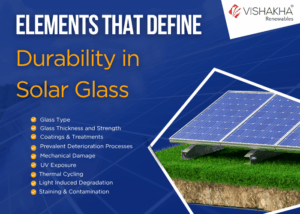
Durability in solar glass is about glass type, strength, coatings, and optical performance. Let’s examine each element.
Glass Type
- Tempered glass: This is the standard trim. It is about four to five times more durable than standard glass. If it does break, it breaks into small dull pieces instead of sharp, dangerous pieces.
- Toughened glass: Toughened glass is similar to tempered glass, but it is sometimes tested for additional strength.
- Low-iron glass: This type of glass has a high light transmittance, which means the cells receive more energy.
- Float glass: Instead of durable glass, float glass is inexpensive and durable and is not used in newer panels.
- Glass with anti-reflective coating (AR): AR coating allows more sunlight to pass through the glass and increases the panel’s light-to-energy conversion.
Glass Thickness and Strength
Typically, the glass falls in the range of 3.2 mm to 4 mm in thickness. Thicker glass generally is more durable when facing impacts, such as hail. But thicker glass also adds weight. Here’s where frame material, such as aluminum, plays an important, although quiet, role. A strong yet lightweight frame can support the glass without adding bulk to the panel.
Coatings & Treatments
- Anti-soil coatings: Minimize dust build-up.
- Anti-UV coatings: Prevent long-term damage from sunlight exposure.
- Hydrophobic coatings: Let water slide right off.
- Anti-reflective coatings: Increase productivity by eliminating glare.
These coatings will prolong the life of glass, but they also wear out. Checking durability means checking how long these coatings last in actual exposure to weather.
Prevalent Deterioration Processes
Despite having robust features, solar glass still has its limits. Years of exposure and other factors can physically degrade the glass and slowly change the performance of your solar panels. In this section, we will address the common causes of deterioration.
Mechanical Damage
Solar panels sit on the roof, exposed to the elements constantly, meaning that hailstorms, fallen tree branches, or rough handling during transport may cause surface cracks, surface chips, or small micro-cracks within the glass surface. These damages may be hard to notice when they initially happen, but damage to the glass can spread over time and allow moisture intrusion, thus degrading panel life.
UV Exposure
The sun is the friend and the foe of solar panel glass. Solar panels rely on direct sunlight to generate energy, and the UV rays can also degrade the surface of the glass, or the protective film on the glass. Over time, UV exposure can lead to discoloration and reduction on efficiency.
Thermal Cycling
Every day, solar panels heat due to direct sunlight and cool after sunset. This thermal fluctuation leads to repeated stresses not only on the glass but other components of the frame. Over time, these stresses can lead to cracks, sealant failure and may even loosen the frame of the solar panel.
Staining & Contamination
Dust from the air, marine salt, or pollutants originating from industrial processes can adhere to the glass surface. This will reduce not only the amount of sunlight the cell receives, but also reduce durability and longevity as well. Salt and moisture are particularly destructive as they corrode the frame and edges, suggesting that durability is a shared experience between the glass and frame.
Light Induced Degradation
Light induced degradation is commonly tied to solar cells but weak or poorly protected glass can help with this process. If the glass compromises the overall system and creates excess stress on the solar cells, efficiency of the overall system will fail more quickly.
How to Evaluate Solar Glass Durability
You don’t have to be a scientist to know about durability testing. The renewable energy industry applies a handful of very straightforward tests to see if glass will be durable.
Visual Inspection
The easiest place to start: look at the glass closely. Signs of durability are things like cracks, chips, yellowing or if a coating is peeling off. These are all indicators that the glass is losing its durability.
Mechanical tests
- Hail test: test every panel by throwing some artificially produced hailstones at the panel to evaluate impact strength.
- Impact resistance: the amount of force the glass can take before breaking.
- Bending test: making sure the panel will not snap after being stressed by snow or wind.
Optical tests
Durability is not only about strength, but clarity as well. By measuring light transmission before and after exposure, you begin to see if coatings such as anti-reflective coatings still work.
Environmental/Weathering Tests
We conduct special tests that simulate years of harsh conditions:
- UV chambers – extent of sunlight exposure
- Salt spray tests – simulate coastal conditions
- Thermal cycling – simulate a hot day and a cold night
Metrics and Standards to Help Evaluate Durability
When comparing different solar panels, the numbers keep the marketers at bay and tell the story.
- Degradation rate: A quality panel should degrade around 0.5% efficiency per year. If the degradation is above 1%, durability could be an issue.
- Mechanical load ratings: The panels need to conform to a national (or international) standard for wind load, snow load, and hail.
- Coating guarantees: Always ask the panel manufacturer how long the AR or hydrophobics last.
- Lifespan guarantees: Reliable manufacturers will give a paired warranty of 25–30 years – this points at durability in the real world.
| Durability Factor | Basic Tempered Glass | AR-Coated Tempered Glass | Low-Iron Toughened Glass | Glass-Glass Panels |
| Thickness (mm) | 3.2–4.0 | 3.2–4.0 | 3.2–4.0 | 2× 2.0–2.5 |
| Mechanical Strength | Good | Very good | Excellent | Excellent |
| UV Stability | Medium | High | High | Very high |
| Soiling Resistance | Low | Medium–High | Medium | High |
| Optical Transmission | Medium | High | Very high | High |
| Typical Lifespan | 20–25 yrs | 25–30 yrs | 25–30 yrs | 30+ yrs |
| Cost | Low | Medium | Medium–High | High |
Choosing Solar Glass for Your Project
Every project exists in its own environment. Here is how to cope:
- If you are on the coast: Choose glass that has anti-salt spray resistance and use a corrosion-resistant aluminum frame.
- If you are in the desert: Select toughened, low-iron glass and preferably it has an anti-soiling coating. Be sure the frame does not bend and will withstand thermal cycling and temperatures.
- If you are in an urban pollution zone: You may wish to use AR-coated tempered glass to lessen the impact of dust and difficulty keeping it clean.
- If you are in a cold climate: Glass-glass panels provide the longest lifespan, but make sure the frame can withstand large snow loads.
It is important to read the specification sheet carefully before your project. Cost is not the only determining factor of durable glass. A little more money at the beginning will likely save you a mountain of trouble later.
Final Takeaway
The toughness of solar glass is truly about the complete package. Strong tempered or toughened glass, coatings that can be trusted, but primarily a supportive frame all work together to keep your panels performing for decades.
So here are the takeaways:
- Look for strength, durability of coatings, and optical quality.
- Review the rates of degradation and warranty.
- Match your local environment with the kind of glass.
Making a wise investment at the beginning of your project means you can expect returns for many years to come. A chain is only as strong as its weakest link, and with solar panels, you want glass and frame to last.
At Vishakha Renewables we help you ensure that link lasts. We recommend only products and materials that we have conducted rigorous durability tests on because we involve frames with glass science to take place. Because a successful project relies on what you can’t see > until it counts.
About Vishakha Renewables
We are leading solar glass manufacturer in India. With production capacity of more than 4GW. Being a preferred partner of Asahi India Glass LTD, we are taking charge of manufacturing durable solar glass and other solar components too.
Delve Deeper and Get to Know More About Solar Glass
Other Articles