Why India Must Shift from Imported Solar Components to Local Supply?
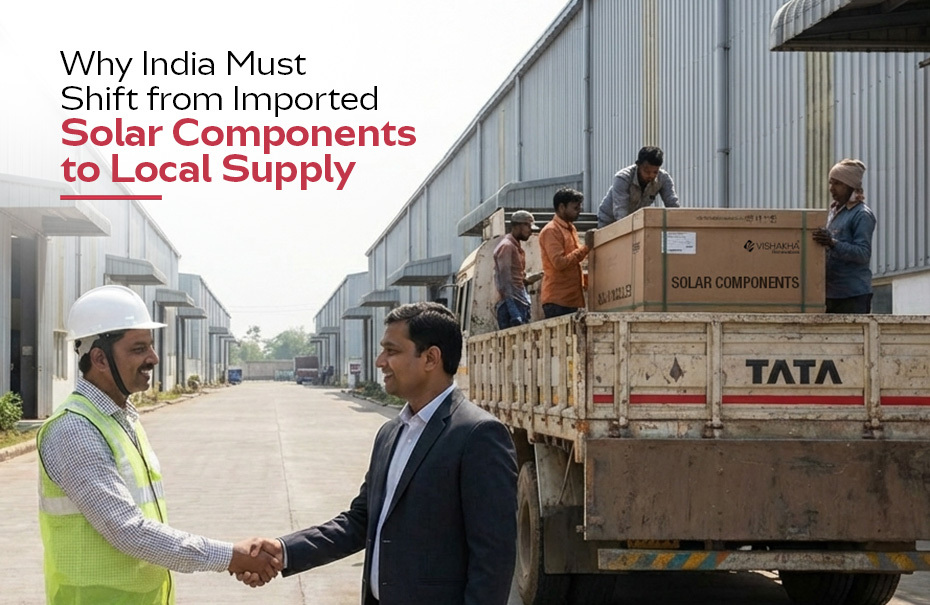
India today stands as a critical juncture in the journey of sustainable energy. With the rapid rise in the demand of electricity, ambitious climate targets and ever-growing dependency on global supply chains especially from country like China, it’s time that we must shift from imported solar components to Made in India solar components manufacturers.
Well, this transition is not merely economic, but its strategic, security-oriented and most important for realizing the full potential for clean energy.
This blog, is all about why must India shift from imported solar components to local supply. We will explore the strategic and security implications of localisation, the economic and environmental benefits of domestic production, and spotlight one of the key players in that transition.
Reasons Why India Must Shift from Imported Solar Components to Local Supply
Strategic & Security Implications
Energy Independence
India’s heavy reliance on imports for key solar components creates a vulnerability.
For instance, primary raw materials such as polysilicon, wafers, cells (especially with high-end PERC/N-type/TopCon technologies) are still dominantly imported.
Now let say if there is a scenario of some geopolitical tensions or supply-chain shock—can ripple through India’s energy transition. What does that mean? It means that any disruption due to such factors-the entire process gets to suffer.
On the other hand, by opting for local manufacturers of solar components, India can enhance its self-reliance in the broader clean-energy value chain.
Supply Chain Resilience
India’s ambitious target of 500 GW of non-fossil fuel capacity by 2030 depends on timely deployment. And at the time of pandemic, the consequent disruptions in supply-chain expose that how fragile concentrated supply can be. Hence, any disturbance could cause project delays, cost overruns, and can stall momentum.
On the other hand, a domestic ecosystem of manufacturing reduces dependence on a few foreign suppliers, ensures consistent availability, and buffers against external shocks—thereby safeguarding the deployment timeline.
Technological Control & Tailored Innovation
Domestic manufacturing is not just about producing parts—it’s about building technological capability. India faces unique climate and site conditions: high ambient temperatures, dust and sand loads (especially in arid or semi-arid zones), monsoonal variability, grid constraints.
Indigenous manufacturing allows R&D to customize solar modules for these conditions—higher temperature resilience, better dust-tolerance, robust frames and backsheets suited for local environments. Control over process, quality, and supply ensures long-term reliability and better adaptation to Indian conditions.
Economic Benefits
Job Creation & Economic Growth
The solar panel is made with 4 primary components – solar frames, backsheet, encapsulants & solar glass. For their manufacturing a strong local solar manufacturing industry generates job across the entire chain which spawns employment, skill-upgradation, trade-link growth in ancillary sectors like logistics, coating, aluminium extrusion and electronics. This not only stimulates local economies but creates a skill-base for the future.
Aligning with National Initiatives – “Make in India” & “Atmanirbhar Bharat”
Localizing solar component manufacturing aligns perfectly with national initiatives like “Make in India” and “Atmanirbhar Bharat” (self-reliant India). The aim is to transform India into a global manufacturing hub, reduce reliance on imports and import bills, and pivot from being a net-consumer to a competitive exporter of clean-energy components.
The basic custom duty on importing solar raw materials was reduced in the 2025-2026 Union Budget; however, pushing domestic production helps build brand-“India” in global supply chains for solar manufacturing.
Fiscal Stability & Foreign Exchange Benefits
Importing large volumes of solar components means outflow of foreign exchange, which places pressure on the current account and leaves the economy exposed to exchange-rate fluctuations and commodity-price volatility (for example, the global polysilicon price spike).
Domestic manufacturing keeps more of the value within the country, reduces import burden, and helps guard against global raw-material price shocks and shipping/logistics disruptions. Over time, this contributes to a more stable fiscal environment and better energy economics.
Environmental & Sustainable Goals
Climate Change Mitigation
Data study says that the India’s commitment is to reduce its carbon footprint and achieve net-zero emissions by 2070, by deploying solar power and utilizing other renewable energy in use. In-house manufacturing accelerates this deployment—thereby enabling faster substitution of fossil fuels with clean power. A healthy local ecosystem means faster turn-around, shorter delivery times, and fewer bottlenecks—supporting the country’s climate ambitions.
End-of-Life Management, Recycling & Mineral Recovery
Manufacturing domestically also provides the opportunity to build integrated lifecycle management—from production to recycling. Solar modules contain valuable and sometimes critical minerals. Having manufacturing and end-of-life recycling infrastructure in India means recovery of such materials, responsible waste-management, and reduced environmental impact. Instead of modules being imported and later discarded with little local control, a domestic ecosystem allows proper stewardship of the full cycle.
Government Policy Instruments
The Indian government has recognised the strategic importance of solar-component manufacturing and is backing it with policy levers. Key among them:
- The Production-Linked Incentive (PLI) scheme for solar modules and components, which offers incentives for domestic manufacturing.
- Basic Customs Duties (BCD) on imported solar cells, modules and certain components, designed to protect domestic manufacturing from cheaper imports and level the competitive field.
These policies send strong signals: manufacturing solar components locally is not only encouraged but increasingly incentivised and protected.
Now that we have discussed the impact of local supply, let’s zoom in on one Indian company playing a pivotal role in manufacturing solar components in India.
Vishakha Renewables, established in 2016. We are specialized in manufacturing critical raw solar panel materials: aluminium frames, back sheets, encapsulants, and solar module glass.
- We are India’s largest integrated aluminium-frame facility, supporting ~3.5 GW output (with plans to scale to 10 GW)
- Our Solar Encapsulant and Solar Backsheet units support ~6 GW each of solar-module installations.
- We possess India’s largest solar glass manufacturing. Our current capacity in Solar Glass manufacturing is 4.8 GW, with a vision to increase to 12 GW soon.
- Our solar materials are recyclable and have the highest levels of light transmission.
Our work illustrates how India can move beyond assembling solar modules to upstream and mid-stream manufacturing of the solar components. These materials (frames, backsheets, encapsulants, glass) are often imported or rely on imported technology/inputs. Vishakha’s model shows how domestic supply chains can be built, thereby reducing dependency, creating jobs, and strengthening the Indian manufacturing ecosystem.
Impacts & Future Potential
- By producing major components locally, Vishakha helps shorten lead times, reduce logistic/shipping risk, and lower costs tied to imports.
- As their capacity scales (frames from ~3.5 GW to 10 GW, etc.), they can serve both domestic demand and potentially export segments.
- The example of companies like Vishakha signals to global investors that India is serious about building manufacturing capacity, which could in turn attract more investment and scale.
India stands at the threshold of a transformative transition in its solar energy sector. To ensure energy security, economic resilience, and fulfil its climate commitments, shifting from imported to local solar components manufacturing is not optional—it is imperative.
When all the solar components are manufactured in India, installed in India and maintained in India; the value will definitely then stay in India and the country will reap the full rewards and will able to achieve the ambition of 500 GW of non-fossil capacity by 2030.
Keep Reading
Other Articles